DubWeaver
🇬🇧ENEnglish
One month free · then $6.99/mo or $49.99/yr

A recording and dubbing studio with AI on your device

Record, direct, mix and deliver. Voice separation, subtitles that write and move themselves, 1,500 sound effects, fifteen looks over the picture and the 5.1 mix — nothing uploaded, no account, no charge by the minute.

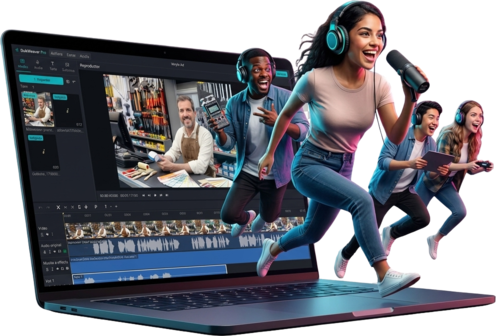
The DubWeaver editor with a film open on the timeline, and the people dubbing it stepping out of the screen.

Three people, one app

The canvas takes the shape of whatever you import, so the app does not care which of these you are.

A film in another language

The AI lifts the original dialogue and leaves the music and effects where they were. You perform against the picture, frame by frame.

Your own video, in a second language

You shot it upright, so it exports upright. Record the other language against your own picture and deliver the same file, differently voiced.

A clip you want to make yours

Take the voice out, keep the music, put yours on — and burn the subtitles into the picture with the app's own fonts.

See it working

Three films and forty screenshots, taken on the machines themselves. Nothing plays until you ask it to.

Open the full gallery

How it works

1 · Bring your film in

Import a video and its audio arrives as its own track. A film with several language tracks lets you pick which ones come in.

2 · Take the voices out

The separation model runs on the device, lifting the original dialogue out and leaving the music and effects behind. If the film already ships a music-and-effects track, DubWeaver finds it and uses that instead — better than anything a model can compute.

3 · Find every line

DubWeaver reads the track once and marks where each line starts and ends — the step Pro Tools calls Strip Silence. The breath before a line is kept and the tail left to decay, and two arrows walk you from mark to mark.

4 · Perform your dub

Arm a take and act while the film plays. Count-in, monitoring through your headphones, and the take lands aligned to the frame. The voice strip — high-pass, compressor, de-esser, EQ and room reverb — plays while you set it, so you hear the room your voice is going into rather than finding out at export.

5 · Add the sound effects

1,500 are built in, from whooshes and risers to applause, door slams and rain. Search by name or category, tap to hear one, star the ones you reach for, and Add puts it at the playhead on a track of its own. Every one is public domain, free to use in the videos you publish. On Android today; iPhone and iPad get them in a coming update.

6 · Caption it, and make the words move

DubWeaver writes the subtitles from what is said, in any of its nine languages, and then they can move: typing, karaoke, a word lighting up as it is spoken, a pop, a fade. Seven styles, each one showing itself in the menu — set one and apply it to every caption on the track in a single press. Titles do all of it too, and what the player shows is what the exported file carries.

7 · Give it a look

Fifteen looks sit in a tab beside Animation, shown as small squares of your own frame already wearing them — you choose by looking, not by reading a menu. Nine are free; the paid six include four that are drawn into the picture rather than graded onto it: a 1970s television, film grain that moves the way stock does, a light leak, and worn tape. A look lives on its own track, so one film can carry several, and the exported file is what the monitor drew.

8 · Deliver the file

Export at full resolution with the captions burned in or alongside as .srt, in stereo or 5.1, at the broadcast loudness the platform you are delivering to asks for. It is a file on your device, made on your device — there is nothing to wait in a queue for and no minute to pay for.

Why on-device matters

Your film never leaves the device

No DubWeaver account, no cloud, nothing uploaded. The app itself only ever downloads: the AI models, once each, and each built-in sound effect the first time you use it, every file checked against a known checksum. The only other connection is Google Play or the App Store confirming your subscription — their link, not ours, and none of it carries your film.

It works with no signal

On a plane, on location, in a basement. Cloud dubbing tools stop being tools the moment the connection does.

Nothing is charged by the minute

One subscription, unlimited minutes, unlimited projects, no watermarks. Dub a feature or a hundred reels for the same price.

It is your voice, not a synthetic one

You dub, or you direct your actor. Real monitoring — 6 to 34 ms on every device measured, from a budget tablet to a current flagship — USB-C microphones, and it refuses to record over a speaker so the mic never hears itself.

The phone edits upright

Every editor a person has used on a phone is portrait, and none of them rotate. DubWeaver does the same: on a phone the timeline is upright, on a tablet it opens out. Vertical in, vertical out.

Subtitles written from the audio, in nine languages

Point it at a track and the words come back with the times they are said at, in any of the nine languages the app speaks — on the device, so nothing is uploaded and nothing is metered. Then burn them into the picture with the app’s own faces, the glyphs the monitor drew with, or hand them over as .srt for whoever asked.

Built to the specifications broadcast actually uses

Most dubbing apps describe their quality in adjectives. These are the standards DubWeaver is measured against, and the measurements are taken on a physical device rather than argued from the source.

Lip sync — EBU R37 / ITU-R BT.1359

The broadcast tolerance for sound against picture is not symmetric: audio may lead the picture by 40 ms and lag it by 60 ms, because a voice arriving early is the one your eye catches. Measured on four physical devices on 3 September 2026, across both platforms and from a budget tablet to a current flagship, a calibrated take landed no more than 11 ms from where it was performed — on every one of them, inside the window many times over. The cheapest of them was 76 ms late without calibrating, which is outside it. Every figure here is taken on a physical device, never argued from the code.

The Calibrador — your device, measured

Cheap hardware lies about its own delay, and dubbing apps inherit the lie. One budget tablet declares 34 ms of round trip and really carries 110 ms — two thirds of its delay invisible to anything that asks politely, and a tenth of a second behind every line you perform. DubWeaver does not guess and does not ship a table of device models: it plays a click train through your headphones, hears it come back through the microphone, and keeps the answer. That same cheap tablet then lands a take 4 ms early — tighter than an uncalibrated flagship, and against 76 ms late without it. Fifteen seconds, once, on any device in the world.

One clock, however many tracks

DubWeaver mixes every track itself and pushes a single stream, so the tracks cannot drift apart — there is nothing to correct, because there was never more than one clock. Measured on four devices: four tracks 0.0 ms from each other on every one of them — not corrected to zero, absent — and sound a median 3–14 ms from the picture on three of the four, against a window that allows 40 ms of lead and 60 of lag. The editor and the export are the same renderer, so what you hear while you work is what the file holds.

Loudness — ITU-R BS.1770 and EBU R128

Loudness is measured with K-weighting and both gates the specification requires, not as an average level. Deliver to −14 LUFS for streaming, −16 for podcast, or −23 for EBU R128 broadcast — or leave the mix exactly as you authored it.

True peak — −1 dBTP, oversampled

A sample peak under 0 dBFS can still clip once a decoder reconstructs the waveform. DubWeaver estimates the true peak at four times the sample rate and holds the EBU R128 ceiling of −1 dBTP with a look-ahead limiter, so nothing distorts on the listener’s player rather than on yours.

Frame rate — VFR handled, NTSC exact

Phone cameras and screen recorders shoot variable frame rate, which is what silently slides a dub out of sync over a long take. DubWeaver normalises it to constant frame rate on the way in and carries NTSC rates as the exact fractions they are (30000/1001), not as the rounded decimals that drift.

Surround — 5.1, placed track by track

Deliver in mono, stereo or 5.1, and put every track where it belongs in the room: pan, front to rear, how much of it anchors to the centre where dialogue lives, and a send to the low-frequency channel that is a 120 Hz crossover rather than a fader. A source exactly as wide as the delivery passes through channel for channel; anything narrower is placed, not stretched. Import a film whose audio is wider than the project and the project widens to match it, rather than folding it down without saying so.

Line detection — the step ADR starts with

A dub begins with somebody deciding where each line starts, over an hour of audio. DubWeaver finds them: it reads the track once and marks every line, and you walk them one at a time — jump, record, jump. It is the same step Pro Tools calls Strip Silence, and it is how every ADR session is prepped. It keeps the breath in front of each line and lets the tail decay, because a cut exactly where the voice starts is audible. And it shows you the count before it marks anything: the gap that separates one line from the next is a slider, and the number moves as you drag it — the track is read once, so a ninety-minute film re-counts instantly.

DubWeaver against cloud dubbing tools

The tools people compare us to are good at what they do — they synthesise a voice on a server. That is a different job from putting your performance on a film, and it is priced and metered differently.

 DubWeaverCloud dubbing tools
Where the AI runs On your device On their servers
Your video is uploaded Never Always
Works with no connection Yes No
Billing One subscription, unlimited minutes Usually per minute or per credit
Whose voice Yours, performed to picture Synthetic, or a clone of one
Timeline editing Frame-accurate, with undo Usually a render queue
Delivery Full resolution, broadcast loudness, 5.1 Varies; often re-encoded to a preset
Subtitles from the audio On your device, nine languages On their servers, usually metered
Account required None Yes

Comparison reviewed on 3 September 2026 against nine named products — HeyGen, ElevenLabs, Rask AI, CapCut Pro, KineMaster, InShot, Descript, Adobe Audition and the offline stem splitters — from the vendors’ own published descriptions and list prices. Entry-tier cloud dubbing ran $0.55 to $2.40 per minute of video at that date. Their features and prices change; check theirs before you choose.

Basic and Pro

The basic tier is a working editor, not a demo: your films open, your takes record against the picture, and nothing is watermarked or expires. Pro is what a dubbing studio is paid for.

 BasicPro
Projects
Basic keeps five — enough for a short film, a trailer and a couple of scenes. If a subscription ends you keep every project you made; what stops is starting the next one.
5Unlimited
AI voice separation
Take the original voices out and keep the music and effects. It runs on your device, so there is nothing to meter: separate a two-minute scene or a two-hour feature, as many times as you like, for the same price. Cloud dubbing tools bill by the minute of video because the computer doing the work is theirs.
—Unlimited
The voice studio
Takes a take recorded on a phone in a bedroom and sits it inside the film: the room comes off it, the level stops lurching, the sibilance stops spitting, and the voice sits where dialogue sits. High-pass, compressor, de-esser, three-band EQ and room reverb — heard while you set them, not discovered at export. An effect already switched on keeps working if a subscription ends.
—Yes
Filters
Nine looks are free, each with its own strength and a vignette: Punch, Amber, Steel, Cinema, Ember, Midnight, Greyscale, Platinum, Ink. The subscription adds six more, and four of those are not a grade at all — they are drawn into the picture: the glow and scanlines of a 1970s set, film grain that moves the way stock does, a warm light leak swelling in from the edge, and a worn tape with its tracking lines and dropouts. Duotone and split tone come with them. You pick a look by looking at it — a small square of your own frame, already wearing it — and put it on its own track, so one film can carry several.
Nine looksAll fifteen
Automatic ducking
The music and effects bed dips under the dialogue by itself, with attack and release you set.
—Yes
Delivery
Full resolution, discrete 5.1, and loudness normalised to streaming, podcast or EBU R128 broadcast.
Up to 720p, stereo Source resolution, 5.1, all targets
No watermark, on either plan
Nothing is stamped on your film, at any resolution, on either tier. The basic editor is smaller, not a countdown: it never expires, and it adds nothing to what you export.
YesYes
Line detection
Find where every line in a track starts and ends, and mark them all — the step a dubbing session begins with, and the one Pro Tools calls Strip Silence. It keeps the breath before a line and lets the tail decay, and shows the count before it marks anything. The work happens on your device, so it costs nothing to give away.
YesYes
Record takes against the picture
Count-in, headphone monitoring, and the take lands aligned to the frame.
YesYes
One clock for every track
DubWeaver mixes every track itself, so they cannot drift apart, and the editor and the export are the same renderer.
YesYes
Frame-accurate editing
Split, trim, ripple, snap, markers, fades, level and pan — and unlimited undo.
YesYes
Subtitles
Import and export .srt, or burn captions into the picture.
YesYes
Subtitles written from the audio
Point it at a track and the words come back with the times they are said at, in any of the nine languages the app speaks, with the language it heard named on the track it makes. It runs on your device, so there is nothing to meter. Basic writes them in one project, with as many tracks inside it as you like.
One projectEvery project
Offline, and private
Everything runs on the device. Your film is never uploaded, with or without a subscription.
YesYes

If a subscription ends, your projects stay yours and stay open. What the basic tier narrows is what can be changed, not what a project already does: a mix you delivered goes on sounding the way you delivered it.

Pricing

One month free. Then one subscription with no watermarks, no project limit and no per-minute charges — separate a two-hour feature as often as you like for the same price.

Annual Best value

$49.99
per year · about $4.17 a month
Save 40% against monthly

Everything, for the price of seven months.

Monthly

$6.99
per month

Everything, month to month.

If your subscription ends you keep your projects and the basic editing tools, so you can always finish by hand and get your work back out. Prices are in US dollars; your store shows the price in your own currency.

Get DubWeaver on Google Play Available for
Android
Download DubWeaver on the App Store Available for
iOS and iPadOS
DubWeaver for macOS, planned In development for
macOS
DubWeaver for Windows, planned Planned for
Windows
DubWeaver for Linux, planned Planned for
Linux

Questions

Is there a free version of DubWeaver?

Yes. The basic tier is a working editor rather than a trial: it never expires, adds no watermark, and lets you keep five projects, cut on a frame-accurate timeline, record dub takes against the picture, burn or export subtitles, and deliver at up to 720p in stereo. A subscription adds the AI voice separation, the voice studio, automatic ducking, full-resolution and 5.1 delivery, broadcast loudness targets, the six paid filters, and unlimited projects. The first month is free.

Can I make animated captions like the ones on Reels and TikTok?

Yes, and they export the way you see them. Seven styles: typing letter by letter with a cursor, a word at a time, karaoke, a word that lights up as it is spoken, a pop, a fade, and plain. Each one animates itself in the menu, so you pick a motion rather than a name. Set one caption and apply it to every caption on the track in a single press, choose the colour the word lights up in, add neon or a drop shadow, and put the line at the top when the bottom of the frame is busy. Titles do all of it too. Nothing is rendered in a cloud: the effect you watch in the player is the one burned into the file.

Can I put a film look on the video — grain, VHS, an old TV?

Yes, and it is drawn rather than faked. Fifteen looks live in a Filters tab beside Animation, each shown as a small square of your own frame already wearing it, so you choose by looking. Nine are free: Punch, Amber, Steel, Cinema, Ember, Midnight, Greyscale, Platinum and Ink, each with its own strength and a vignette. The subscription adds six, and four of those are not a colour grade at all — they are painted over the picture: the glow and scanlines of a 1970s television, film grain that moves the way stock does, a warm light leak that swells in from the edge, and a worn tape with its tracking lines and dropouts. Duotone and split tone come with them. Each look sits on its own track, so one film can carry several, and the exported file is what the monitor drew.

Does it work for Reels, Shorts or TikTok?

Yes, when the clip is already vertical. The canvas takes the shape of the first video you import, so a 9:16 source is edited at 9:16 and delivered at 9:16. A landscape film is edited and delivered landscape — the app dubs what you give it and hands back the same shape.

Can I dub my own video into a second language?

That is the shortest path through the app. Import your own video, take the original voices out, record the other language against your own picture, and export the same file differently voiced. The music and effects stay where they were.

Does it add subtitles?

It imports .srt, lets you write and time captions yourself, burns them into the picture with the app’s own fonts, and exports .srt for whoever asked. Burned captions carry the styling the editor shows rather than a player’s defaults. It writes them for you, on the device, in any of the nine languages the app speaks — point it at a track and the words come back with the times they are said at, and the language it heard is named on the track it makes. Or write them yourself, or import the .srt.

Does DubWeaver charge per minute of video?

No. The AI runs on your own phone or tablet, so there is no server time to bill: separating a two-minute scene and a two-hour feature cost the same, and doing it again costs nothing more. Cloud dubbing tools meter by the minute or by credits because the computer doing the work is theirs. DubWeaver is $6.99 a month or $49.99 a year, whatever you put through it.

Does my video get uploaded anywhere?

No. Video, audio and projects are stored on your device and nowhere else. There is no DubWeaver account and no cloud. The app itself only downloads what it needs: the AI models, once each, and each built-in sound effect the first time you use it — every file verified against a known checksum. The only other connection is Google Play or the App Store confirming your subscription, which is their link rather than ours. None of it carries your video, your audio or your projects.

Does it really work offline?

Yes, once the AI models have been downloaded. Separating voices, recording, mixing and exporting all happen on the device with no connection at all. A built-in sound effect needs a connection the first time you play or add it, and stays on the device from then on. Those downloads, each checked against a known checksum, are the only requests the app makes; the only other connection is the store confirming your subscription.

Can I use the built-in sound effects in videos I publish?

Yes. DubWeaver comes with 1,500 sound effects — whooshes, risers, applause, door slams, rain, cartoon boings and more, in 52 categories — and every one is in the public domain (CC0), so you can use them in anything you publish, commercial work included, with no credit owed. Search them by name or by category in your own language, tap to listen, star the ones you use, and add one at the playhead in a single press. They come with every plan, the basic one included, in the Android app.

Which languages can I dub into?

Any language you can speak. DubWeaver removes the original voices and records yours; it does not translate and it does not synthesise, so you are not limited to a list of supported voices. The app’s own interface is in nine languages, which is a separate thing from what you dub into.

What languages is the app itself in?

Nine: English, Spanish, Portuguese, French, Italian, German, Japanese, Simplified Chinese and Russian. It follows your device and you can change it whenever you want. If your language is not one of the nine, the app stays in English rather than showing you a half-translated screen.

How good is the voice separation?

It runs the same class of model the desktop tools use, and it gives the same result whatever you run it on: measured on 3 September 2026, the voice comes down about 11 dB on a current phone and on a budget handset several years old alike, with the music and effects bed moved 0.0 dB on either. An older device waits longer; it does not get a worse separation. Results vary with the material rather than the hardware: a mix that never separated cleanly will not separate perfectly here either. If the film already carries a music-and-effects track, DubWeaver uses that instead, which is better than any model.

Does DubWeaver meet broadcast standards?

Yes, and it names them. Sound against picture is held inside the EBU R37 and ITU-R BT.1359 window of 40 ms lead and 60 ms lag. Loudness is measured to ITU-R BS.1770 with K-weighting and gating, and delivered at -14 LUFS for streaming, -16 for podcast or -23 for EBU R128 broadcast. True peak is estimated at four times the sample rate and limited to the EBU R128 ceiling of -1 dBTP.

How accurate is the lip sync?

Once the Calibrador has run, a take lands no more than 11 ms from where it was performed — on every device measured, from a budget tablet to a current flagship, on the devices themselves on 3 September 2026. Without calibrating, the cheapest of them is 76 ms late. The EBU R37 broadcast tolerance allows audio to lead the picture by 40 ms and lag it by 60 ms, so this sits inside it many times over. The asymmetry is deliberate in the standard: a voice arriving early is the one the eye catches. DubWeaver measures this on physical devices on every test run rather than inferring it from the code.

What if my device is slower than that?

Some devices under-report their own audio delay, and a few report none at all. Run the Calibrador from the Edit menu: it plays a click train through your headphones, hears it come back through the microphone, and keeps the answer, so takes land where you performed them on any device. One budget tablet declares 34 ms, really takes 110, and lands a take 76 ms late without the Calibrador — outside the broadcast window. With it, the same tablet lands 4 ms EARLY, better than an iPad manages uncalibrated. It is optional, it takes about fifteen seconds, and dubbing works without it.

Can I export in surround?

Yes. Stereo or discrete 5.1, at the resolution of your source, normalised to streaming, podcast or broadcast loudness targets. Each track is placed rather than stretched: pan, front to rear, centre, and a send to the low-frequency channel that is a 120 Hz crossover rather than a fader.

What happens if I cancel?

You keep your projects and a set of basic editing tools, so you can open, finish by hand and export work you have already made. What stops is starting the next thing: AI separation, the voice chain, ducking and full-resolution 5.1 delivery. An effect already switched on can still be adjusted or turned off. Cancelling before the free month ends costs nothing.

Can it split a film into its lines?

Yes, and it is the step a dubbing session actually starts with. DubWeaver reads the track once and marks where every line begins — the same step Pro Tools calls Strip Silence, and how ADR sessions are prepped. It keeps the breath in front of each line and lets the tail decay rather than cutting exactly where the voice starts, which is audible. You see the count before anything is marked, and the silence that separates one line from the next is a slider whose number moves as you drag it: the track is read once, so re-counting a ninety-minute film is instant. Then you walk the marks one at a time — jump to the line, record it, jump to the next. It marks rather than cuts, so a detection you disagree with is ignored rather than undone.

Which devices does it run on?

Android phones and tablets from Google Play, and iPhone and iPad from the App Store. The built-in sound effects are in the Android app today; iPhone and iPad get them in a coming update. A macOS build runs too — the films in the gallery were made on one — but it is not published yet, so there is no way to install it today. On 3 September 2026 it was put on four physical devices — from a budget tablet to a current flagship — covering both platforms and both phone and tablet layouts, with four audio tracks playing and not one dropout on any of them. Voice separation is heavy work: it needs a reasonably recent device and enough free memory, and the app tells you honestly when a device cannot do it.
One month free · then $6.99/mo or $49.99/yr